
You collect survey data to make better decisions. But what happens when that data falls into the wrong hands?
Last year, a major retail chain exposed 1.5 million customer survey responses containing personal information, purchase habits, and income details. The breach cost them $4.2 million in fines, countless hours of damage control, and something money can’t buy back—customer trust.
Your survey data is a goldmine of sensitive information. And hackers know it.
Table of Contents
The Hidden Value of Your Survey Data
Think about what you’re collecting. Names. Email addresses. Phone numbers. Demographics. Opinions about products, services, and competitors. Health information. Financial status. Employee feedback about workplace conditions.
Each survey response creates a detailed profile of a real person. Stack thousands of these profiles together, and you have exactly what cybercriminals want—a comprehensive database of personal information ready for exploitation.
The average survey contains 15-20 data points per respondent. Multiply that by your response rate, and you’re sitting on thousands, maybe millions, of valuable data combinations.
Identity thieves can use this information to:
- Open credit accounts
- File fraudulent tax returns
- Access existing accounts
- Create convincing phishing campaigns
- Sell data packages on the dark web

The Real Cost of a Survey Data Breach
Financial Impact
The numbers hurt. IBM’s 2023 Cost of a Data Breach Report shows the average breach costs organizations $4.45 million. For companies handling survey data, costs include:
- Regulatory fines (GDPR violations can reach 4% of annual revenue)
- Legal fees and litigation
- System repairs and security upgrades
- Customer notification expenses
- Credit monitoring services for affected individuals
- Lost business from damaged reputation
Legal Consequences
Data protection laws don’t care if you meant well. GDPR, CCPA, PIPEDA, and dozens of other regulations hold you responsible for every piece of data you collect. Fail to protect survey responses, and you face:
- Government investigations
- Compliance audits
- Mandatory breach notifications
- Public disclosure requirements
- Personal liability for executives
Trust Destruction
Here’s what keeps smart executives awake: 65% of consumers say they’ve lost trust in organizations after a data breach. Once trust breaks, it rarely returns.
Your respondents shared their thoughts, experiences, and personal details because they believed you’d protect them. Break that trust, and watch response rates plummet. Future surveys fail. Decision-making suffers. Business stalls.
Common Security Mistakes That Leave You Exposed
Using Basic Survey Tools
Free and cheap survey platforms often skip serious security measures. They store data on shared servers, use outdated encryption, and offer minimal access controls. You save money upfront but gamble with your entire business.
Weak Access Management
How many people can access your survey data? If you answered “I’m not sure,” you have a problem.
Most breaches happen because someone who shouldn’t have access does. Former employees retain login credentials. Team members share passwords. Admin rights spread without oversight.
Poor Data Handling Practices
Your data’s journey matters. Where does it go after collection? Who downloads it? What happens to exported files?
Common mistakes include:
- Emailing raw data files
- Storing responses on personal devices
- Using unsecured cloud storage
- Keeping data longer than necessary
- Mixing test and production data
Building Your Survey Security Framework
Start With Encryption
Encrypt everything. Data in transit needs TLS 1.3 or higher. Data at rest requires AES-256 encryption. No exceptions.
Your survey links should always start with “https://” – never “http://”. Check that your survey platform encrypts databases, backups, and any exported files.
Implement Strong Authentication
Passwords alone don’t cut it anymore. You need multi-factor authentication (MFA) for anyone accessing survey data.
Set up role-based access control (RBAC). Give people the minimum access they need. Review permissions quarterly. Remove access immediately when someone leaves your organization.
Choose Your Platform Carefully
Your survey platform becomes your security partner. Ask potential providers:
- What certifications do you hold? (Look for SOC 2, ISO 27001, HIPAA compliance)
- Where do you store data?
- How do you handle breaches?
- What’s your encryption standard?
- Can you sign a Business Associate Agreement (BAA)?
- Do you offer audit logs?
Create Data Handling Protocols
Document how your team should handle survey data:
- Never download data to personal devices
- Use secure file transfer methods
- Delete local copies after processing
- Anonymize data when possible
- Set automatic deletion schedules
- Limit data sharing to encrypted channels
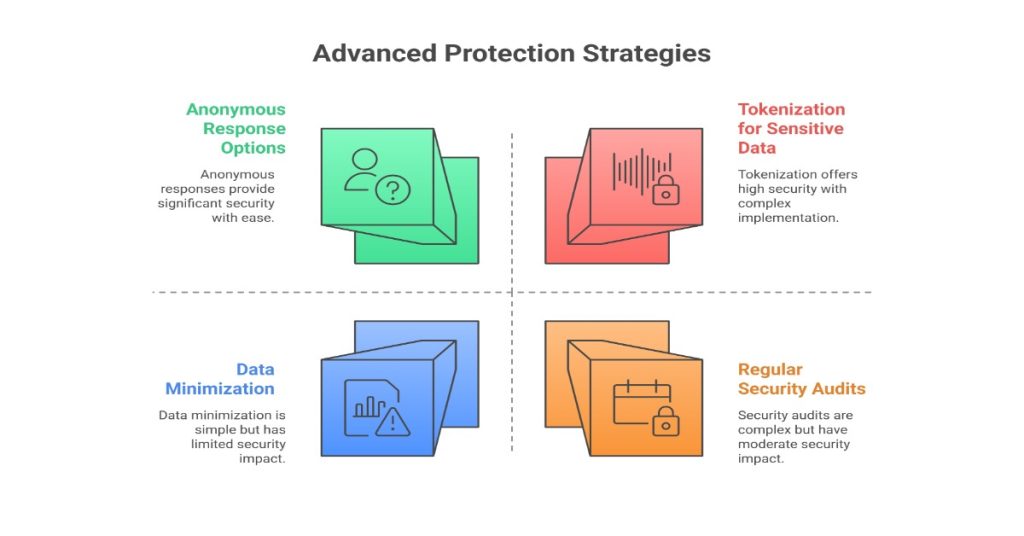
Advanced Protection Strategies
Data Minimization
Collect less, risk less. Every question should serve a specific purpose. Can you get insights without collecting names? Do you need exact birth dates, or would age ranges work?
Before adding a question, ask: “What decision will this data drive?” If you can’t answer clearly, cut it.
Regular Security Audits
- Schedule quarterly reviews of:
- User access lists
- Data storage locations
- Third-party integrations
- Compliance requirements
- Incident response plans
Anonymous Response Options
Offer anonymous surveys when personal identification isn’t necessary. You’ll get more honest feedback while reducing security risks.
Tokenization for Sensitive Data
Replace sensitive information with randomly generated tokens. Store the actual data in a separate, highly secured vault. Even if someone breaches your survey database, they get meaningless tokens instead of useful information.
Creating Your Incident Response Plan
When (not if) something goes wrong, speed matters. Your plan needs:
Immediate Actions (First 24 hours)
- Isolate affected systems
- Assess the breach scope
- Notify legal counsel
- Document everything
Communication Strategy (24-72 hours)
- Prepare stakeholder notifications
- Draft customer communications
- Contact regulatory bodies
- Engage PR support if needed
Recovery Process (72 hours onward)
- Implement security patches
- Restore secure operations
- Conduct post-incident review
- Update security measures
The Competitive Advantage of Superior Security
Companies with strong data security see unexpected benefits:
- Higher survey response rates (respondents trust secure organizations)
- Better data quality (people share more when they feel safe)
- Faster regulatory approvals
- Reduced insurance premiums
- Stronger partner relationships
Microsoft saw a 23% increase in survey participation after publicizing their enhanced security measures. Respondents explicitly mentioned security as a factor in their decision to participate.

Take Action Today
Survey data security isn’t optional anymore. It’s a business imperative that affects your bottom line, reputation, and ability to operate.
Start here:
- Audit your current survey security measures
- Identify your biggest vulnerabilities
- Update your survey platform settings
- Train your team on security protocols
- Create or update your incident response plan
Read More
AI Tools for Analyzing Customer Reviews: The 2025 Buyer’s Guide

Beyond the Survey: 7 Questions That Uncover What Customers Really Think

Strategies to Expand Your Survey Reach Across Different Demographics
Every day you delay increases your risk. Your competitors are tightening their security. Regulators are watching closer. Hackers are getting smarter.
Protect your survey data like your business depends on it. Because it does.
The question isn’t whether you can afford to prioritize survey data security. It’s whether you can afford not to.
Your respondents trusted you with their information. Don’t let them down.