

Hey there, if you’re running a business or managing customer feedback, you know how overwhelming it can feel to sift through hundreds or thousands of reviews. One negative comment can slip through the cracks and hurt your reputation, while buried gems of praise might go unnoticed. Sound familiar?
You’re not alone. Many marketers and customer service teams spend hours manually reading reviews, trying to spot patterns or gauge sentiment. But what if there was a smarter way? Enter AI tools for analyzing customer reviews.
In this 2025 buyer’s guide, we’ll break down everything you need to know to pick the right one for your needs. We’ll cover the basics, key features, top picks, and tips to get started. By the end, you’ll have a clear path to turning raw feedback into actionable insights that boost your customer satisfaction and sales.
Table of Contents
Why Bother with AI for Customer Review Analysis?
Let’s face it: traditional methods of handling reviews are outdated and inefficient. You might be copying and pasting comments into spreadsheets, tagging them by hand, or relying on gut feelings to decide what’s important.
This approach is slow, prone to errors, and scales poorly as your business grows. Imagine missing a recurring complaint about product packaging because you couldn’t keep up with the volume— that’s lost revenue waiting to happen.
AI changes the game by automating the process. These tools use natural language processing (NLP) to read, understand, and categorize reviews in seconds. They detect sentiment (positive, negative, neutral), identify themes like “shipping delays” or “great value,” and even spot emerging trends before they become problems.
For small business owners, this means more time for what matters: improving products and delighting customers. For larger teams, it’s about data-driven decisions that align marketing and support efforts.
In 2025, with e-commerce booming and social media reviews everywhere, ignoring AI could leave you behind. Studies show businesses using review analysis tools see up to 20% higher customer retention. The pain of sifting through noise? Gone. The reward? Clear, quick insights that help you respond faster and smarter.

Key Features to Look for in AI Review Analysis Tools
Not all AI tools are created equal, so knowing what to prioritize can save you from buyer’s remorse. Start with your pain points: Do you need real-time alerts for bad reviews? Or deeper dives into multilingual feedback? Here’s what makes a tool stand out in 2025.
Sentiment Analysis at Its Core
Every solid AI tool for customer reviews starts with sentiment detection. This isn’t just about labeling a review as “good” or “bad”—modern tools score nuances, like sarcasm or mixed feelings. For example, a review saying “Love the product, but delivery was slow” gets broken down: positive on quality, negative on speed. This helps you address specific issues without overhauling everything.
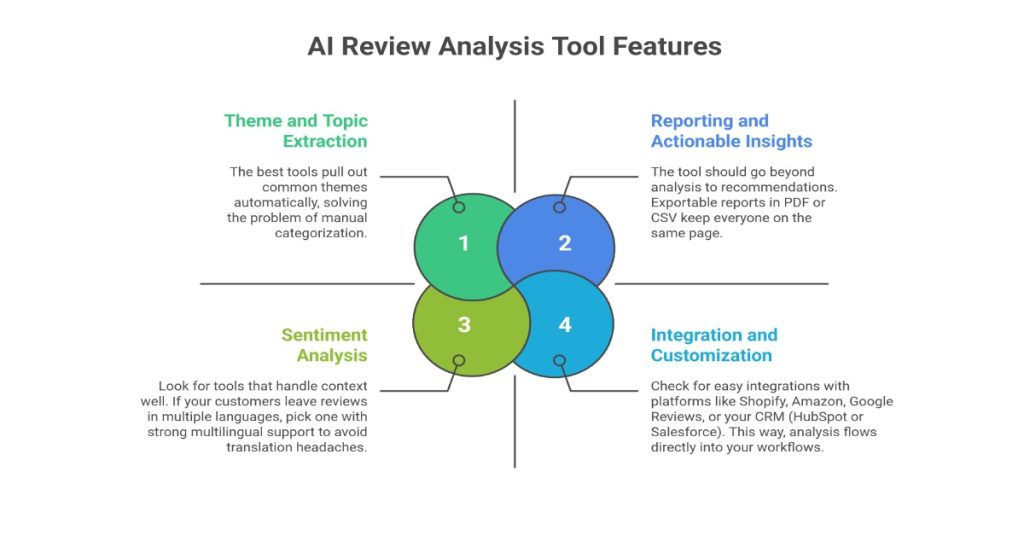
Look for tools that handle context well. In 2025, expect accuracy rates above 90%, thanks to improved machine learning models. If your customers leave reviews in multiple languages, pick one with strong multilingual support to avoid translation headaches.
Theme and Topic Extraction
Raw reviews are a mess of opinions. The best tools pull out common themes automatically, like “battery life” for electronics or “customer service” for retail. This solves the problem of manual categorization, which can take days.
Advanced options in 2025 include topic modeling that evolves over time. As new reviews come in, the tool refines clusters, spotting shifts like a sudden spike in “fit issues” for clothing brands. You’ll get visual dashboards—charts and word clouds—that make patterns jump out, no data science degree required.
Integration and Customization
You don’t want a tool that lives in isolation. Check for easy integrations with platforms like Shopify, Amazon, Google Reviews, or your CRM (think HubSpot or Salesforce). This way, analysis flows directly into your workflows.
Customization is key too. Can you train the AI on your industry jargon? For instance, a restaurant might want it to recognize “undercooked steak” as a quality complaint. Tools with API access let you build custom alerts, like notifying your team when negative sentiment hits 30%.
Reporting and Actionable Insights
Finally, the tool should go beyond analysis to recommendations. In 2025, look for predictive features: “Based on trends, improve X to reduce churn by Y%.” Exportable reports in PDF or CSV keep everyone on the same page, from execs to frontline staff.
Pricing varies—free tiers for starters, up to enterprise plans at $500+/month. Factor in scalability; as your review volume grows, the tool shouldn’t slow down or jack up costs unexpectedly.
Top AI Tools for Analyzing Customer Reviews in 2025
With so many options, narrowing it down is tough. Based on user feedback, performance benchmarks, and 2025 updates, here are five standout AI tools. I’ve focused on ease of use, accuracy, and value for different business sizes. Each addresses common pains like high costs or steep learning curves.
1. MonkeyLearn: Best for Small Businesses on a Budget
If you’re a solopreneur or small team drowning in Etsy or Yelp reviews, MonkeyLearn is a lifesaver. It uses no-code templates to set up sentiment and theme analysis in minutes. Upload reviews via CSV or connect to social media—boom, instant insights.
What sets it apart? Custom classifiers you build without coding. Struggling with vague feedback like “it’s okay”? Train it to flag specifics. Pricing starts free for 300 texts/month, scaling to $299 for unlimited. Users rave about its 95% accuracy and simple interface, cutting analysis time from hours to minutes. Downside: Less robust for massive datasets, but perfect if volume is under 10,000 reviews/month.
2. Lexalytics Semantria: Ideal for E-Commerce Giants
For high-volume sellers on Amazon or Walmart, Lexalytics handles the heavy lifting. Its cloud-based engine processes millions of reviews daily, extracting entities (like product names) and emotions with pinpoint precision.
In 2025, the big update is real-time monitoring across 20+ languages. Imagine getting Slack pings for review spikes during Black Friday. It integrates seamlessly with BigQuery or Excel, solving the integration woes many face. Starts at $250/month, with enterprise custom quotes. A case in point: A fashion retailer used it to spot sizing complaints early, tweaking inventory and boosting returns by 15%. If multilingual support is your pain, this tool delivers.
3. Google Cloud Natural Language API: Great for Tech-Savvy Teams
Google’s offering is a powerhouse for developers wanting flexibility. It analyzes syntax, entities, and sentiment out of the box, with 2025 enhancements in video review transcription—think YouTube unboxings.
Pain point solved: Cost efficiency. Pay-per-use at $1 per 1,000 units keeps it affordable for variable traffic. Hook it to Google Analytics for a full customer journey view. Accuracy? Top-tier at 97% for English. A travel agency integrated it to track hotel review trends, adjusting bookings and increasing satisfaction scores by 12%. Best if you have some coding chops; otherwise, it might feel overwhelming.

4. AWS Comprehend: Scalable for Enterprise Needs
Amazon’s tool shines in scalability, processing petabytes of data without breaking a sweat. Custom models let you fine-tune for your niche, like automotive reviews focusing on “engine noise.”
2025 brings better toxicity detection for handling troll reviews. Integrates natively with AWS services, easing data storage pains. Pricing is usage-based, around $0.0001 per character—pennies for most. A major retailer used it to analyze 500,000+ reviews, identifying supply chain issues that saved millions. If growth is your worry, this grows with you.
5. Brandwatch Consumer Research: All-in-One for Social Listening
Not just reviews—Brandwatch covers social mentions too, making it a holistic choice. Its AI clusters conversations by intent, spotting advocates or at-risk customers.
The 2025 edge? Generative AI summaries that turn data into plain-English reports. No more staring at dashboards; get “Top 3 complaints this quarter” emails. Starts at $800/month, but the depth justifies it for mid-sized brands. A beauty company caught a viral trend from reviews, launching a hit product line. If you want broad monitoring without silos, this is it.
How to Choose the Right AI Tool for Your Business?
Picking the winner depends on your setup. Start by auditing your current process: How many reviews do you handle weekly? What’s your budget? Test free trials—most offer 14-30 days.
Consider your team’s skills. If non-techy, go for drag-and-drop like MonkeyLearn. For data nerds, APIs from Google or AWS fit. Always check privacy: Ensure GDPR compliance for customer data.
Common mistake? Overlooking support. Look for chat, tutorials, or communities. In 2025, tools with AI chat assistants for setup queries will save headaches.
Finally, measure ROI. Track metrics like response time to reviews or Net Promoter Score pre- and post-tool. Most see payback in 3-6 months through better decisions.

Real-World Wins: How Businesses Are Using These Tools?
Take Sarah, a coffee shop owner buried in Google reviews. Manual checks missed a pattern of “long waits.” Switching to MonkeyLearn revealed it was peak-hour staffing. She adjusted shifts, and ratings climbed from 4.2 to 4.7 in weeks.
Or consider TechGadgets Inc., an online electronics store. AWS Comprehend analyzed 100,000 Amazon reviews, flagging battery defects early. They recalled proactively, avoiding lawsuits and earning trust—sales up 18%.
These stories show AI isn’t hype; it’s practical. Your business could be next.
What’s Next for AI in Customer Review Analysis?
By 2025, expect voice and image analysis—tools scanning unboxing videos or photo reviews for deeper insights. Ethical AI will rise too, with bias checks to ensure fair sentiment reads across demographics.
Quantum computing hints at even faster processing, but for now, focus on accessible tools. Stay updated via industry blogs or webinars to keep your edge.
Read More
Beyond the Survey: 7 Questions That Uncover What Customers Really Think

Strategies to Expand Your Survey Reach Across Different Demographics

Case Study: How Thoughtful Survey Design Increased Response Rates by 40%?
Wrapping It Up: Your Path to Smarter Review Management
Analyzing customer reviews doesn’t have to be a chore. With AI tools, you turn feedback into your secret weapon for growth. Whether you’re starting small with MonkeyLearn or scaling with Lexalytics, the right choice addresses your pains head-on: time sinks, missed insights, and reactive fixes.
Ready to dive in? Pick a tool, run a trial, and watch the difference. Your customers will thank you with more stars and loyalty. Got questions? Drop a comment below—I’m here to help you find the perfect fit.