

Research is the backbone of any smart decision. Whether you are launching a new product, studying social trends, or just trying to understand your employees better, you need reliable data. However, gathering that data is often a massive headache. You might struggle with high costs, slow results, or data that is just too messy to use effectively.
If you have ever tried to schedule fifty interviews or analyze a mountain of handwritten notes, you know the pain. You run out of time, you run out of money, and you often end up with more questions than answers.
This is where questionnaires come in. They are one of the most reliable tools for gathering information quickly and effectively. While they might seem simple, they solve many of the biggest pain points researchers face: lack of budget, strict time constraints, and the difficulty of reaching a large enough audience to make your findings matter.
In this guide, we will look at exactly why using questionnaires can turn a difficult, expensive research project into a manageable and successful one.
Table of Contents

1. You Save Significant Money
One of the biggest hurdles in any research project is the cost. If you rely on traditional methods like face-to-face interviews or focus groups, you will burn through your budget faster than you expect.
Consider the expenses involved in a standard interview process:
- Personnel costs: You have to pay trained interviewers for their time.
- Travel expenses: If your subjects are in different cities, you are paying for flights, hotels, and meals.
- Venue costs: Focus groups often require renting a specific facility with recording equipment.
For a small business, a student, or a non-profit, these costs are often impossible to cover.
How Questionnaires Cut Costs?
Questionnaires are incredibly cost-effective. Digital tools allow you to send a survey to thousands of people via email or social media for free or for a very small subscription fee. Even if you choose to use paper surveys, the cost of printing and postage is still a fraction of what you would spend on travel and salaries.
By cutting these logistical costs, you can spend your budget on what really matters: analyzing the results and taking action on what you find. You get the same level of insight without the heavy price tag.
2. Reaching a Large Audience is Easy
Imagine trying to interview 500 people face-to-face. Even if you did three interviews a day, it would take you nearly six months to finish. A common pain point for researchers is the “sample size” problem—not having enough data to make a solid conclusion. If you only talk to ten people, you cannot say for sure that their opinions represent everyone else.
Breaking Down Geographical Barriers
Questionnaires solve this by allowing you to scale up instantly. The internet has no borders. You can gather opinions from customers in London, employees in New York, and partners in Tokyo—all on the same day, without ever leaving your desk.
This global reach is crucial for modern businesses. If you sell products online, your customers are everywhere. A local focus group won’t tell you why your sales are dropping in another country. A well-distributed questionnaire will.
Mass Data Collection for Better Statistics
Because you can reach so many people so easily, your data becomes more statistically significant. Collecting responses from hundreds or thousands of participants gives your research “weight.” When you present your findings to stakeholders or professors, being able to say “we surveyed 1,000 people” carries much more authority than “we spoke to a few guys.”

3. Participants Are More Honest
People often feel pressure when they are speaking to an interviewer. They might give the “socially acceptable” answer rather than the truth because they don’t want to look bad or offend the person asking the questions.
For example, if you ask an employee, “Do you like your boss?”, they will almost always say “Yes” to an interviewer’s face, even if they are unhappy. This is called social desirability bias, and it ruins your data. It leads you to make decisions based on polite lies rather than hard truths.
The Power of Anonymity
Questionnaires, especially digital ones, offer a shield of privacy. When there is no one watching and no voice recording them, respondents feel free to share their true thoughts.
- Reduced pressure: Participants can admit to bad habits, unpopular opinions, or dissatisfaction without fear of judgment.
- Better accuracy: If you are asking about sensitive topics like health, income, or workplace satisfaction, you want the raw truth. Anonymity supports that honesty.
When people feel safe, they open up. This gives you deeper, authentic insights into what they actually think and feel, rather than what they think you want to hear.
4. The Data is Easy to Analyze
Qualitative data—like long interview transcripts or open-ended conversations—is rich, but it is also messy. It takes ages to read through, categorize, and interpret. If you need quick answers, wading through hours of audio recordings is a major bottleneck. You might spend weeks just transcribing the audio before you even start looking for patterns.
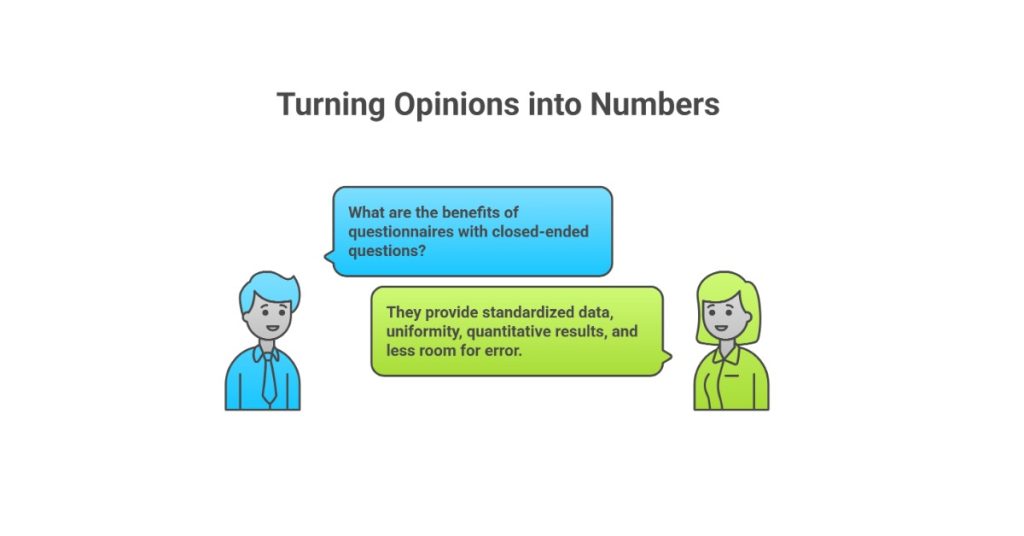
Turning Opinions into Numbers
Questionnaires, particularly those with closed-ended questions (like multiple choice, Likert scales, or Yes/No boxes), provide standardized data.
- Uniformity: Every participant answers the exact same question in the same format. You don’t have to worry about an interviewer changing the phrasing and confusing the subject.
- Quantitative results: You can turn check-boxes into numbers, charts, and graphs instantly. Modern online survey tools will often do this for you automatically, creating visual reports the moment the data comes in.
- Less room for error: You don’t have to worry about interpreting a participant’s tone of voice or vague phrasing. The data is right there in black and white.
This structure allows you to spot trends and patterns quickly. You can see immediately that “70% of customers prefer the blue packaging,” which allows you to make a fast, data-backed decision.
5. Respondents Can Answer on Their Own Schedule
Phone interviews often interrupt people at dinner. Focus groups require people to travel to a specific location at a specific time, often during their workday. These inconveniences reduce your response rate because people are simply too busy to help you.
If you make it hard for people to participate, they won’t. It is that simple.
Respecting the Participant’s Time
Questionnaires respect the respondent’s schedule. A participant can fill out your survey at midnight, during their lunch break, or while riding the bus. They are in control.
- Flexibility: They can pause and come back to it if they get interrupted.
- No pressure to rush: Respondents can take their time to think about their answers without an interviewer waiting impatiently for a reply. This often leads to more thoughtful responses.
When you make it convenient for people to participate, more people will do it. This leads to higher response rates and a more representative sample of the population.
6. Speed: From Launch to Insight in Hours
In the business world, speed is often just as important as accuracy. If you need to decide on a marketing campaign for next week, you cannot wait two months for a study to finish.
Traditional research methods are slow. You have to recruit participants, schedule times that work for everyone, conduct the sessions, transcribe the data, and then analyze it.
Rapid Turnaround
With a questionnaire, you can drastically cut down this timeline. You can design a survey in the morning, email it to your list by noon, and start seeing results come in by the afternoon.
Because the data collection happens automatically (you don’t need to be there to “receive” the answers), you can gather data while you sleep. By the time you wake up, you might already have enough responses to see a clear trend. This speed allows businesses to be agile and reactive, fixing problems or seizing opportunities before competitors catch on.

7. Consistency and Standardization
One subtle but dangerous pain point in research is interviewer variability. If you hire three different interviewers, they will all ask questions slightly differently. They might use different tones of voice or body language that influence how the person answers. This makes it hard to compare the results. Is the difference in the data because of the customer, or because of the interviewer?
The Same Experience for Everyone
Questionnaires eliminate this variable. Every single person sees the exact same question, in the exact same font, with the exact same answer options.
This standardization makes sure that your data is valid. You can be confident that a difference in answers is due to a difference in opinion, not because one interviewer was grumpy and the other was cheerful. This reliability is essential if you want to track changes over time, such as sending out the same survey once a year to measure progress.
Read More
Keyword Extraction From Reviews: How AI Boosts Signal to Noise

Putting Customers First: Practical Strategies for Long-Term Business Success

Streamlining Data Analysis: Online Survey Tools vs Offline Questionnaire Processing
The Bottom Line
Questionnaires are not just a “backup” option for when you can’t afford interviews; they are a powerful strategy for modern research. They tackle the most common frustrations—high costs, slow timelines, small sample sizes, and messy data—and replace them with efficiency and clarity.
By using questionnaires, you gain the ability to listen to a massive audience without breaking the bank. You get honest answers that are easy to turn into action. You get the data you need, in a format you can use, at a speed that keeps up with the real world.
So, before you plan your next big project, consider how a simple questionnaire might be the smartest tool in your kit. Stop guessing what your audience thinks, and just ask them.