
We’ve all been there. You spend weeks crafting the perfect survey, send it out to your audience, and eagerly await the results. The data comes in, you analyze it, and make a critical business decision. Then, slowly, you realize something is off. The feedback doesn’t match reality. The culprit? Questionnaire bias.
Bias in surveys is an invisible saboteur. It silently distorts your data, leading to inaccurate results and misguided strategies. Whether you’re measuring customer satisfaction, employee engagement, or market trends, a biased instrument will give you a flawed map. Your journey will be doomed from the start.
The good news is that mitigating bias is a skill you can master. By understanding its sources and implementing rigorous design techniques, you can transform your questionnaires into precise tools that capture truth, not distortion. This guide delves into the practical, human first strategies to ensure your survey results are robust and reliable.
Table of Contents
Why Bias Creeps Into Our Questions?
Bias isn’t usually intentional. It sneaks in through our assumptions, our word choices, and our design shortcuts. We are all human, and our perspectives shape how we frame questions. The first step in eliminating survey bias is recognizing its many forms.
Leading questions are the classic offender. They subtly prompt the respondent toward a particular answer. For instance, How excellent did you find our customer service? assumes the service was excellent. A neutral alternative is, How would you rate our customer service?
Social desirability bias pushes people to answer in a way that makes them look good. Questions about health habits, financial behavior, or workplace ethics are particularly vulnerable. Respondents might under report unpopular opinions or over report virtuous ones.
Sampling bias occurs when your questionnaire doesn’t reach a representative slice of your target population. If you only survey users of your mobile app via email, you’re missing those who prefer the web platform. Your data reflects a skewed sample, not your whole audience.

Core Techniques for Crafting Neutral and Effective Questionnaires
1. The Art of Neutral Question Wording
Every word matters. Avoid loaded or emotional language. Instead of Do you support the devastating policy changes? use What is your view on the recent policy changes? Strip away adjectives and adverbs that carry judgment. This is fundamental to unbiased survey design.
Use simple, clear language accessible to all education levels. Avoid jargon and technical terms unless your audience is specifically expert. Ambiguity is a breeding ground for bias. If a question can be interpreted in two ways, it will be.
2. Balance Your Scales and Response Options
Response bias often lives in the answer choices you provide. An agree disagree scale that leans positive, for example Excellent, Great, Good, Fair, lacks a truly negative option. Use balanced scales with equal numbers of positive and negative points.
Always include a neutral midpoint, such as Neither agree nor disagree. Forcing a choice can create false data. For multiple choice questions, ensure your options are mutually exclusive and collectively exhaustive. Consider if an Other please specify field is necessary to capture answers you haven’t anticipated.
3. Structure and Order: The Sequencing Effect
The order of your questions can influence survey responses. Early questions can set a context that colors later answers. This is called the priming effect. Start with broad, neutral questions before moving to specific or sensitive topics.
Similarly, a series of questions all framed in one direction can create acquiescence bias, where respondents start automatically agreeing. Be mindful of how one question flows into the next. Group related topics together to create a logical flow that feels natural, not manipulative.
4. Demographics: Ask, Don’t Assume
Demographic questions are powerful, but they must be inclusive. Provide a range of options for gender, age, ethnicity, and other identifiers. Use open ended fields or Prefer to self describe options when possible. This practice of improving questionnaire accuracy also shows respect for your respondents’ identities.
Place these personal questions at the end of the survey. By then, the respondent is engaged and more likely to answer, and you’ve avoided opening with questions that might feel intrusive or lead to early drop offs.

5. Pilot, Test, and Iterate
Never launch a questionnaire untested. Conduct a cognitive pre test with a small, diverse group. Ask them to verbalize their thought process as they answer. Where do they hesitate? What words confuse them? This is your single best tool for reducing measurement error.
A pilot run with a small sample from your target population can reveal flaws in logic, sequencing, and technical function. Analyze the pilot data for red flags, like a 90 percent skew toward one answer, which may indicate a leading question. Then, refine relentlessly.
People Also Ask: Navigating Common Concerns
What are the most common types of bias in questionnaires?
The most prevalent forms include leading bias, questions that suggest an answer, acquiescence bias, the tendency to agree, social desirability bias, giving the right answer, sampling bias, flawed respondent selection, and question order bias. Understanding these categories is the first step in designing effective survey questions that counteract them.
How does question wording affect survey results?
Dramatically. A single loaded word can shift responses by significant percentages. For example, asking about assistance to the needy versus welfare programs elicits different reactions. Wording shapes the mental frame through which respondents view the issue, directly impacting data quality and the validity of your results.
Can the order of questions really change the answers?
Absolutely. This is a well-documented phenomenon. An early question can establish a context or bring certain ideas to mind, influencing later responses. For instance, asking first about overall political satisfaction, then about a specific policy, will yield different results than reversing that order. Careful survey structure is crucial for neutral data collection.
How do I ensure my sample isn’t biased?
Use a random sampling method whenever possible from your entire target population. If using a panel, understand its composition. For email lists, recognize who is on them. Often, you’ll need to use stratified sampling, deliberately seeking out respondents from key subgroups, to ensure demographic balance and representativeness in your data.
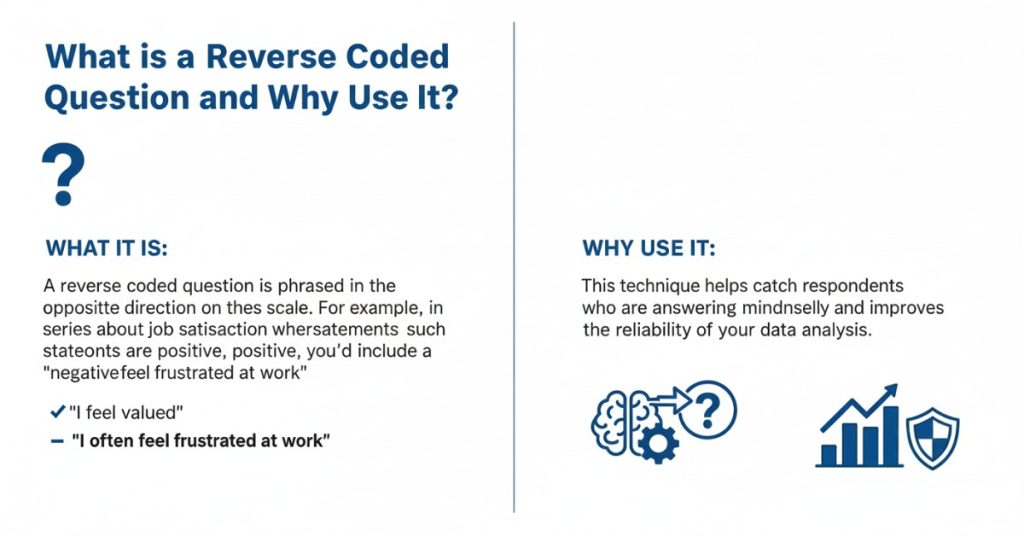
What is a reverse coded question and why use it?
A reverse coded question is phrased in the opposite direction of other questions on a scale. For example, in a series about job satisfaction where most statements are positive, such as I feel valued, you’d include a negative one, such as I often feel frustrated at work. This technique helps catch respondents who are answering mindlessly and improves the reliability of your data analysis.
Read More
Driving Results with Customer Experience Best Practices

Keeping Responses Confidential with Anonymous Surveys

Limiting Bias Through Effective Sampling Error Control in Online Surveys
From Theory to Practice: A Final Checklist
Before you hit send, run through this final audit. Have you used neutral, simple language? Are your scales balanced? Is the question order logical and non priming? Are demographic questions inclusive and placed appropriately? Did you do a pilot test with real people?
Mitigating bias is an exercise in humility. It requires us to challenge our own assumptions, to see our questions through the eyes of others, and to relentlessly pursue clarity. It’s not a one time fix but a core discipline of any researcher or business leader who trusts data.
The goal is a questionnaire that acts as a clear window, not a funhouse mirror. By investing in these techniques, you ensure the insights you gather are reflections of reality, giving you the confidence to make decisions that are truly informed. Your data, and your decisions, will be all the stronger for it.